Industrial Kitchen Design Elements: What Actually Works vs. What Just Looks Cool in Photos
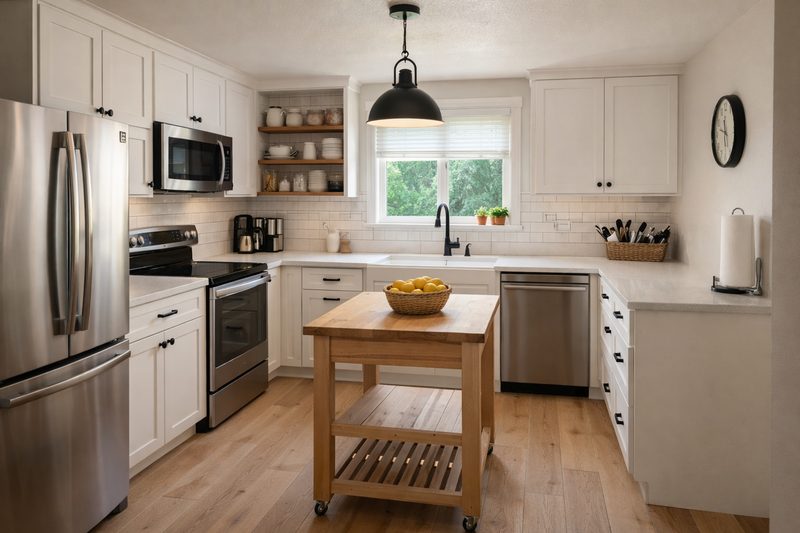
Industrial kitchen design looks incredible in photos. Exposed brick. Concrete countertops. Open metal shelving. Commercial-style fixtures in matte black or brushed steel. The whole thing feels like a New York loft that somehow ended up in a suburban home.
I’ve installed more kitchens than I can count over the past 20-plus years. I’ve also had more than a few conversations with homeowners who came in with a folder full of industrial kitchen photos and very specific ideas about what they wanted. Some of those projects came out exactly as the photos promised. Others turned into lessons about the difference between how something photographs and how it actually functions in a home kitchen.
Here’s the contractor’s perspective on industrial kitchen design: what works, what costs more than people expect, and how to find the line between raw and livable.
What “Industrial” Actually Means in a Kitchen
Industrial design pulls its language from commercial and manufacturing spaces: warehouses, factories, professional kitchens, machine shops. The aesthetic celebrates materials in their honest state. Steel shows its weld marks. Concrete shows its grain. Brick shows its age. Wood shows its wear. Nothing is hiding what it is.
In a kitchen, this translates to: exposed structure where possible, materials that can take abuse, open storage rather than concealed cabinets, fixtures that look like they belong in a restaurant rather than a showroom, and a palette of raw, industrial tones - charcoal, slate, aged steel, warm concrete, aged wood.
The appeal makes sense. There’s honesty to industrial design that a lot of people respond to. It doesn’t pretend to be something it isn’t.
The challenge is that a home kitchen isn’t a factory. You need it to function for daily cooking, to be manageable to clean, to store everything a modern household needs, and to hold up to years of real use. The gap between industrial aesthetics and home kitchen function is where most of the complexity lives.
Exposed Brick: Real vs. Faux
Exposed brick is the most requested element in industrial kitchens, and it’s also the most location-dependent.
If the brick is already there, exposing it is usually straightforward: demo the drywall covering it, clean and seal the brick. The cost is labor and sealing material. The result is authentic because it is authentic. That’s the brick that was always there.
If there’s no brick, you have two options: real thin-brick veneer or faux brick panels.
Real thin-brick veneer is exactly what it sounds like. Slices of real brick, about half an inch thick, adhered to the wall. Done right, it looks genuine because the material is genuine. Cost ranges from $15 to $35 per square foot installed depending on your market and the brick style. For a 10-foot kitchen backsplash run, you’re looking at $300 to $700 just for that wall, plus installation.
Faux brick panels are a faster, cheaper option. They can look decent in certain applications and from certain distances. In a kitchen where people are standing a few feet away while cooking and cleaning, the difference between real and faux usually shows. If your budget doesn’t support real thin-brick and you want the look, it can work - just go in knowing what it is and choose the best-quality panels available.
My honest take: real brick veneer in an industrial kitchen is worth doing if you can budget for it. The faux version satisfies the visual at a lower price but doesn’t carry the same weight. That said, half a roll of real brick is better than a full wall of fake.
In a kitchen, you also need to think about where the brick lives relative to your cooking and cleaning zones. Brick near the cooktop or behind the sink requires proper sealing to resist grease and moisture. Skip the sealing step and you’ll spend years fighting staining and water infiltration. Seal it properly and it’s completely manageable.
Concrete Countertops: The Full Story
Concrete countertops are one of the most polarizing elements in kitchen design. People either love them or find out too late that they’re not the right material for how they cook.
The appeal is obvious. Concrete has a look that nothing else replicates: thick, substantial, with natural variation in tone and texture. In an industrial kitchen, it belongs in a way that granite or quartz often doesn’t.
Here’s what I tell every homeowner who asks about concrete countertops before they commit.
They require maintenance. Concrete is porous. Without proper sealing and resealing every year or two, it stains. Acidic foods, oils, coffee, wine - these all leave marks on unsealed or improperly sealed concrete. Sealing prevents this, but it’s an ongoing commitment, not a one-time task. If you cook a lot and you’re not willing to reseal countertops regularly, concrete is going to frustrate you.
They can crack. Concrete settles and shifts with temperature and humidity changes. Hairline cracks are common and in an industrial aesthetic they actually look intentional. But larger cracks are a problem and can be expensive to repair properly.
They’re heavy. A concrete countertop is significantly heavier than granite or quartz. Your cabinet bases need to be solid enough to support the weight. In older kitchens, this sometimes means reinforcing the cabinet structure before the concrete goes in. This adds cost that isn’t always factored into the initial estimate.
The cost is comparable to high-end stone. Concrete countertops typically run $75 to $150 per square foot installed, depending on thickness, edge profile, and your region. That’s in the range of premium granite and sometimes higher than engineered quartz. It’s not the budget option people sometimes assume.
Done right, they’re exceptional. I’ve installed concrete countertops that are still looking great a decade later in clients’ homes because the homeowners understood the maintenance commitment going in. The material rewards proper care.
If you love concrete and are willing to maintain it, go for it. If you want the look without the maintenance, concrete-look quartz is a legitimate alternative. It photographs nearly identically to real concrete and requires almost no ongoing care.
Metal Open Shelving
Open metal shelving is probably the most practical industrial element you can add to a kitchen without major structural work. Pipe and wood floating shelves, welded steel brackets with solid wood planks, raw steel angle-iron shelves - all of these are achievable at a range of price points and they make an immediate visual impact.
The functional reality of open shelving in a kitchen is worth discussing honestly. Open shelves look great with the right items displayed on them. They require more daily maintenance than closed cabinets because everything is visible and everything collects grease and dust. In a kitchen where you cook regularly, the dishes, glasses, and pantry items on those shelves need to be wiped down more often than you’d think.
The homeowners who love open shelving are the ones who have a curated, organized collection of kitchen items they actually use. The ones who regret it are the ones who discovered that their actual kitchen stuff looks cluttered on open shelves.
In a mixed approach, open metal shelving works best for the items you use daily: the everyday plates, the glasses, a few cookbooks, the olive oil and salt you reach for constantly. Closed cabinetry handles the rest. This hybrid approach is more functional than going full open shelving throughout and still delivers the industrial aesthetic.
For the hardware, pipe-and-flange systems allow you to build adjustable industrial shelving yourself for a fraction of custom fabrication cost. Black iron pipe fittings with solid wood shelving planks is an affordable DIY-friendly option that reads as genuinely industrial.
Commercial-Style Fixtures and Hardware
This is the area where industrial kitchens often diverge between what works in a restaurant and what makes sense in a home.
Faucets. Commercial-style pull-down faucets with a spring neck and professional sprayer look the part in an industrial kitchen. Most of the major fixture brands make residential versions of this look that are scaled and pressure-rated for home use. These work well and they’re worth the investment - a good fixture in a kitchen is used dozens of times a day. Matte black and brushed stainless are both appropriate for the industrial palette.
Lighting. Industrial pendant lights over an island or peninsula are one of the most impactful and relatively affordable changes you can make. Caged Edison pendants, schoolhouse lights in matte black, large industrial pendant drums in aged brass or flat black - all of these anchor the industrial aesthetic without requiring structural work. Make sure the scale is right: oversized pendants can overwhelm a small kitchen and undersized ones look lost in a large space.
Cabinet hardware. Matte black, brushed steel, and aged brass are the right choices for industrial kitchens. Simple bar pulls and cup pulls in these finishes are more appropriate than decorative or ornate hardware. Keep it utilitarian.
Ventilation hoods. A stainless steel or matte black range hood in an industrial style is a statement piece. Wall-mount and island-mount hoods in raw stainless or a ductless black finish can become the visual anchor of an industrial kitchen. The commercial-inspired look reads as functional, which is exactly the right signal for this style.
The Balance Between Raw and Livable
Here’s the contractor truth: the industrial kitchens that work best in real homes are the ones that balance the raw elements with enough livability that the kitchen is genuinely pleasant to use every day.
Full industrial, top to bottom, with exposed concrete everywhere, only metal surfaces, no warmth, no organic material, no soft edge - this often looks better in a photo than it does to cook in. It can feel cold and harsh in daily use. The kitchen is the most-used room in most homes. You want it to feel good, not just look correct.
The balance points that I’ve seen work consistently:
Warm wood as a counterpoint to metal and concrete. A wood island top alongside concrete perimeter counters. Wood open shelving against a metal grid background. Reclaimed wood floating shelves on a bare concrete or whitewashed brick wall. The warmth of wood prevents the kitchen from going full warehouse.
Intentional imperfection without neglect. Industrial design celebrates materials that show their history. A concrete countertop with natural variation. Brick with visible mortar variations. Aged wood with real grain. But “showing history” is different from “looking unmaintained.” There’s a quality threshold below which “raw and authentic” becomes “just worn out.”
Function first. Cabinet storage in an industrial kitchen serves the same purpose as in any other kitchen. You need enough closed storage for the things that belong out of sight. Open shelving is part of the aesthetic, but it has to work as real storage, not just a display case.
What Going Fully Industrial Actually Costs
To give you real numbers for a genuine industrial kitchen transformation:
Exposed or faux brick backsplash area: $400 to $1,200 for a typical backsplash run, depending on real vs. veneer.
Concrete countertops (30 linear feet): $3,500 to $7,500+ installed.
Metal open shelving (4 runs, 36 inches each): $600 to $2,000 depending on custom fabrication vs. pipe-and-flange DIY.
Commercial-style faucet: $200 to $600 for a quality residential version.
Industrial pendant lighting (3 over island): $300 to $900 depending on fixture choice.
Range hood in industrial style: $400 to $2,500+ depending on size and finish.
This is before cabinetry, appliances, and general kitchen renovation costs. Industrial elements add cost to a kitchen project, not savings. Know that going in.
Before you commit to specific elements and start getting contractor bids, see the direction in your actual kitchen. ReVision AI lets you take a photo of your kitchen and see an industrial style transformation in seconds. That preview tells you whether the direction works in your specific space before you spend anything on materials or labor.
Browse the full design style library to compare industrial against contemporary, farmhouse, and other kitchen-friendly options.
The Bottom Line on Industrial Kitchens
Industrial kitchen design is achievable in a home setting, but it requires understanding the gap between how the style photographs and what it takes to execute well and maintain long-term. The materials are honest. The look is strong. And the cost of doing it right is real.
Start with the elements that have the highest impact at the most manageable cost: industrial pendant lighting, matte black hardware, commercial-style faucet, and open metal shelving. See how that direction feels in the space before committing to the concrete countertops and the brick installation.
Measure twice, cut once. That goes for design decisions as much as lumber.
Get Design Inspiration Weekly
Fresh room makeover ideas, renovation tips, and style guides delivered to your inbox.
Design tips and inspiration only. Unsubscribe anytime.
Related Articles
AI Interior Decorator: How It Works and What It Can Actually Do
An AI interior decorator turns a photo of your room into styled design options in seconds. Here's how it works, what it nails, and where it falls short.
8 min readPaint AI Color Visualizer App: See the Color on Your Walls Before You Buy a Gallon
A paint AI color visualizer app shows real wall colors in your own room before you buy a single gallon. Here's how I use one on real jobs as a contractor.
6 min readDecorate With AI: How to See Your Room Restyled Before You Spend a Dime
Want to decorate with AI but not sure where to start? Here's how a third-generation carpenter uses it to test styles, layouts, and colors before buying.
8 min read