Small Bathroom Renovation Ideas on a Budget: Real Costs, Real Results
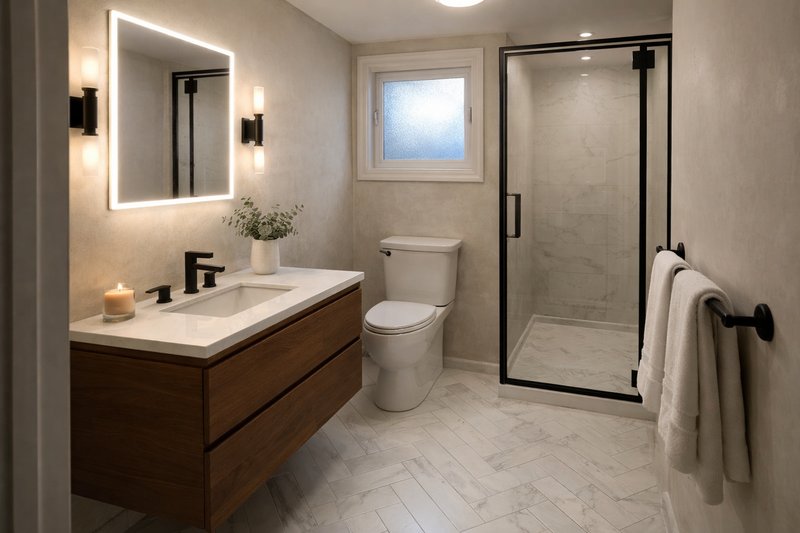
I’ve been in a lot of small bathrooms. Some were tight 5x8 builder-grade spaces that hadn’t been touched since the 1970s. Some were tiny primary baths that homeowners had given up on because they didn’t think there was anything worth doing with them. Almost all of them had more potential than the owners realized.
Let me give you the straight story on small bathroom renovations: what they actually cost, what moves the needle, what’s a waste of money, and where the real risks are if you cut corners.
The Three-Tier Reality
Before we talk specifics, understand that small bathroom renovation breaks down into three pretty distinct tiers. The tier you choose depends on your goals, your timeline, and your honest budget.
Tier 1: Cosmetic Refresh ($2,000 - $5,000)
This is surface-level work. You’re not moving walls, pipes, or electrical. You’re changing what you see.
What this covers:
- Fresh paint (walls, ceiling, and trim)
- New vanity light fixture and mirror
- New faucet and hardware
- New toilet seat or full toilet replacement
- New accessories (towel bars, toilet paper holder, robe hook)
- Refinishing or reglazing the tub and tile instead of replacing
- New flooring if you’re using peel-and-stick vinyl or affordable LVP
A cosmetic refresh can genuinely transform the feel of a bathroom. I’ve walked clients through this process and they’re stunned by the result. But the key word is honest: this works when the underlying structure is sound. If you have a dated but fully functional bathroom in a solid house, a cosmetic refresh is the most efficient dollar-for-dollar investment you can make.
The reglazing point deserves its own mention. If your tub or tile is stained, discolored, or just ugly but structurally fine, reglazing is a fraction of the cost of replacement. A quality reglaze job can last 10 years with proper care. On a tight budget, this is often the right call.
Tier 2: Mid-Range Remodel ($8,000 - $15,000)
Now you’re getting into real renovation territory. This tier covers partial replacement: new vanity, new tub or shower surround, possibly new tile, and updated plumbing fixtures.
What this covers:
- Full vanity replacement (not just refinishing)
- New tub or prefab shower enclosure
- Tile work on floors and possibly walls
- New toilet
- Updated lighting and ventilation fan
- Basic plumbing fixture upgrades
The $8,000 end of this range assumes simple layouts, no surprises behind the walls, and standard materials. The $15,000 end accounts for more complex tile work, a tile shower instead of prefab, better fixtures, and a small amount of contingency.
In a small bathroom, you’re dealing with a tight space which actually limits labor time in some ways but creates challenges in others. Working in a 5x8 is slower per square foot than working in a larger space. Material waste is higher because of all the cuts. Don’t let the small square footage fool you into thinking it’ll be cheap.
Tier 3: Full Gut and Rebuild ($15,000 - $25,000+)
Everything comes out. Tile, drywall, subfloor, possibly down to the studs. You’re starting fresh and doing it right.
This is the tier that shocks most homeowners. They expect a small bathroom to be cheap because it’s small. But a full gut remodel in a 40-square-foot bathroom has similar fixed costs to a larger one: permits, demo labor, licensed plumber, licensed electrician if the panel needs updating, tile setter, new subfloor, moisture barrier, drywall, fixtures, and finish work. The space being small saves some material cost but not much on labor.
In the Pacific Northwest, Tier 3 is often what’s needed because of what we find behind the walls.
The PNW Moisture Warning
If you’re in Washington, Oregon, or anywhere with similar climate, listen up. Moisture is the enemy, and it hides well.
I’ve opened up small bathroom walls expecting a straightforward tile replacement and found the subfloor completely rotted through from a slow leak nobody noticed for years. I’ve pulled a vanity and discovered black mold behind the drywall that required full remediation before we could do anything else. I’ve seen shower surrounds that looked fine from the outside and were concealing active water damage that had been working its way into the framing for a decade.
This is why I tell every client the same thing: add 15-20 percent to your budget for surprises, because there are always surprises. Not maybe. Always.
In a bathroom, water is everywhere: behind the shower, under the toilet base, around the vanity plumbing, in the subfloor. Old caulk fails. Old tile grout cracks and lets water through. Old supply lines corrode. Older homes have original cast iron or galvanized pipes that are past their service life. You don’t know what’s there until the walls come open.
The good news is that catching this stuff in a renovation is cheaper than dealing with it after the fact. A rotted subfloor found during demo is a manageable repair. The same rot discovered after you’ve already installed your new tile is a disaster.
What to Spend Money On
There are places where cutting costs is smart and places where it’s a mistake you’ll regret. Here’s the short version.
Do not cheap out on waterproofing. The shower walls, the pan, the subfloor, the transitions: all of it needs proper waterproofing done by someone who knows what they’re doing. A cheap waterproofing job on a tile shower is not a bargain. It’s a ticking clock. In three to five years, that water finds its way through and you’re tearing it all out again. Do it right the first time.
Do not cheap out on plumbing. If a licensed plumber tells you the supply lines need to be replaced or the drain needs to be rerouted, trust that call. Amateur plumbing work in a bathroom creates moisture problems, code violations, and liability down the road. This is not the place to save $500 by letting your buddy handle it.
Do not cheap out on the exhaust fan. In a small bathroom, ventilation is everything. A properly sized, quality exhaust fan that actually moves air prevents mold, protects your paint, and extends the life of every other thing you just paid to install. The $25 builder-grade fan is not the answer.
Do not use drywall as a backer in wet areas. Regular drywall behind tile, even painted drywall, fails when it gets wet. Cement board, moisture-resistant drywall, or a proper tile backer is required in any area with regular water contact.
Where You Can Save Money
Now for the flip side.
Hardware and accessories. Towel bars, toilet paper holders, robe hooks - the quality difference between budget and premium in these categories is minimal. Pick something that matches and move on.
Mirrors. A large, frameless mirror from a home improvement store does the same job as a designer mirror at 10 percent of the price. In a small bathroom, a big mirror makes the space feel twice as large. That’s the functional win. You don’t need custom framing to get it.
Vanity lighting. You can find solid fixtures in the $80-150 range that look clean and modern. Lighting is one of the highest-impact changes you can make in a bathroom, and you don’t have to spend $400 to make it work.
The toilet. Unless you have specific comfort or water efficiency requirements, a mid-grade toilet in the $200-400 range performs as well as one costing three times that. Save the money for things that matter more.
Tile choices. Large-format tile can make a small bathroom feel more spacious, and it requires fewer grout lines, which means less maintenance. But you don’t need imported marble to achieve a clean, modern look. Domestic porcelain tile in the right size and finish gives you 90 percent of the result at a fraction of the cost. Save the budget for things that matter more.
Making a Small Space Feel Larger
This is the design challenge in every small bathroom: you can’t physically change the square footage, but you can change how it feels.
A few things that work:
Large-format floor tile. Fewer grout lines trick the eye into reading the floor as larger. 12x24 tiles on a small bathroom floor can make it feel significantly more open than 4x4 mosaic.
A floating vanity. Mounting the vanity to the wall and leaving the floor visible underneath opens up the space visually. It also makes cleaning easier, which is a bonus.
A clear glass shower enclosure. In bathrooms with tubs or showers, replacing a shower curtain or opaque doors with frameless clear glass keeps the sightlines open. The eye travels through the glass to the back wall, and the room reads as larger.
Consistent color palette. High contrast between wall color, floor, and fixtures fragments a small space. A tighter palette in lighter tones keeps things cohesive and open-feeling.
Good lighting. A dark bathroom feels smaller than it is. Better fixtures, warm color temperatures, and sometimes adding a recessed light changes everything.
Before you commit to a direction, it’s worth seeing what the finished result could look like in your actual space. ReVision AI lets you take a photo of your bathroom and see different style transformations before you spend a dollar. That’s a lot better than choosing tile in a showroom and hoping it looks right at home.
Getting Accurate Bids
If you’re working with a contractor, a few things to know about the bidding process.
Get at least three bids. Make sure every bid covers the same scope. Ask each contractor to break down materials and labor separately. Ask specifically how they handle surprises: if they open the wall and find rot, how does that get priced and communicated?
Be wary of the low bid. I’ve seen this play out hundreds of times. A low bid wins the job, work starts, and then the change orders start arriving. The homeowner is stuck at that point. The walls are open. The old fixtures are gone. Switching contractors mid-project is a nightmare. The cheap bid ends up costing more than the honest one would have.
Good, fast, or cheap. You can pick two. That’s as true in a bathroom remodel as it is anywhere else in construction.
The Bottom Line
Small bathrooms are worth renovating. They’re one of the highest-return rooms in the house, both for your daily quality of life and for resale value. But they’re not cheap to do right, and cutting corners in a bathroom creates problems that compound over time.
Know your tier going in. Budget for surprises. Spend where it counts. Save where it doesn’t. And do the waterproofing right the first time.
If you’re still figuring out the direction for your bathroom before you start calling contractors, download ReVision AI and see what your space could look like in different styles. Get the vision locked in first. Everything else follows from there.
Get Design Inspiration Weekly
Fresh room makeover ideas, renovation tips, and style guides delivered to your inbox.
Design tips and inspiration only. Unsubscribe anytime.
Related Articles
The Best Free Home Remodel App (From a Contractor Who Uses One)
A free home remodel app can show you the finished room before demo day. Here's what to look for, what free really means, and how to test one right.
8 min readAI Remodel Kitchen: How I'd Preview a Kitchen Before Spending a Dollar
An AI remodel kitchen tool lets you see new cabinets, counters, and layouts before demo day. Here's how I'd use it as a contractor to plan a kitchen right.
8 min readRenovate With AI: How to Remodel Your Home Before You Spend a Dime
Use a renovate AI home remodel app to preview any room in seconds. See how to picture your space transformed before you ever swing a hammer or sign a bid.
8 min read